
By Patrick Cooney, for AMRC
FEDERAL AGENCY NEWS
FY27 Trump Budget Raises NIH Funding Concerns Again
The Trump Administration’s fiscal year 2027 budget proposal signals a renewed push to reshape federal health policy priorities in ways that could significantly affect the clinical research ecosystem. Congress rejected similar proposals in FY26. In an election year, given the makeup of the current Congress, it is hard to see how President Trump’s budget proposal for FY27 gets much traction.
While the “Make America Healthy Again” (MAHA) agenda is not prominently featured in the Administration’s messaging, the proposal advances a sweeping reorganization of the Department of Health and Human Services (HHS), including the creation of a new “Administration for a Healthy America” (AHA). This entity would consolidate key agencies such as the Substance Abuse and Mental Health Services Administration (SAMHSA), the Health Resources and Services Administration (HRSA), and portions of the Centers for Disease Control and Prevention (CDC), with an increased focus on nutrition, food and drug safety, and chronic disease prevention.
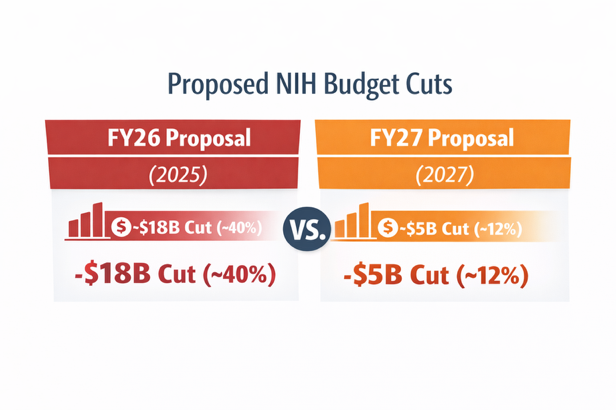
At the same time, the Trump Administration is proposing substantial funding reductions that raise concerns for research stakeholders. The budget requests $111.1 billion in discretionary HHS funding—a 12.5% cut from FY2026 levels—and includes a $5 billion reduction to the National Institutes of Health (NIH). Additional cuts target the Agency for Healthcare Research and Quality (AHRQ) and the Administration for Strategic Preparedness and Response (ASPR), alongside the elimination of programs previously rejected by Congress. The consolidation of programs under AHA is framed as an effort to eliminate duplication and redirect resources away from diversity, equity, and inclusion (DEI) and certain public health initiatives, which could further reshape federal research priorities and funding streams.
For the clinical research community, these proposals present both uncertainty and potential opportunity. Reductions in NIH and related agencies could constrain grant funding, slow innovation pipelines, and impact site-level research capacity. At the same time, increased emphasis on FDA modernization, AI integration, and alternative testing methods may open new avenues for research partnerships and regulatory innovation.
FDA Reported to Be Shifting Internal AI Platform
The latest reporting on FDA’s internal AI platform, Elsa, suggests the agency may be shifting the underlying model environment used in regulatory workflows, a development that clinical research sponsors should watch closely. A recent Clinical Leader article says Elsa is moving from Anthropic’s Claude to Google’s Gemini amid a broader HHS phaseout of Claude, raising questions about continuity, validation, and data governance during FDA review activity. Whilen the FDA has not publicly confirmed that specific model change in the agency announcements reviewed for this article, the agency has made clear that Elsa is now embedded in review operations and that AI will play a growing role in pre-market review, post-market surveillance, inspections, and administrative functions. In June 2025, FDA said Elsa had already begun helping staff “accelerate clinical protocol reviews, shorten the time needed for scientific evaluations, and identify high-priority inspection targets.”
When Elsa launched agency-wide, Commissioner Marty Makary said the tool followed a “very successful pilot program with FDA’s scientific reviewers” and emphasized that it was rolled out “ahead of schedule and under budget.” FDA also stressed that Elsa was “built within a high-security GovCloud environment” and that its models “do not train on data submitted by regulated industry,” a point that will be especially important to companies submitting proprietary clinical, manufacturing, and safety data. FDA expanded those capabilities in December 2025 with “agentic AI,” saying the new deployment could harness “various AI models” for more complex tasks and was already being used voluntarily by more than 70% of staff, according to internal agency data. For AMRC members, that means the practical question is less whether FDA will use AI and more how changes in the agency’s AI stack could affect review consistency, timing, and sponsor confidence in regulatory handling of submissions.
For clinical research sponsors, the key near-term issue is transparency and operational predictability. If Elsa’s model foundation is changing, sponsors will want assurance that FDA maintains consistent controls around confidentiality, record integrity, and review reliability. That concern is heightened because FDA is simultaneously encouraging broader AI adoption both internally and across regulated development. CDER stated in January 2026 that it has seen a significant rise in submissions with AI components and that the agency’s 2025 draft guidance is intended to support a risk-based framework for AI used in regulatory decision-making for drug and biological products. AMRC may want to frame this development not as a reason for alarm, but as a reason for engagement: members should continue monitoring FDA’s public statements, seek clarity where needed on review processes involving AI, and be prepared for a regulatory environment in which FDA’s own use of AI becomes more sophisticated, more common, and more consequential.
Executive Order Imposes Tariffs on Imported Patented Drugs and Key Components
On April 2, 2026, the Trump Administration issued an executive order that would significantly restructure the U.S. pharmaceutical supply chain by imposing tariffs on imported patented drugs and their key components. The order, developed under Section 232 of the Trade Expansion Act of 1962, frames pharmaceutical import dependence as a national security vulnerability and signals a major shift in federal policy toward trade-based intervention in the life sciences sector.
According to the order, more than half of patented drugs consumed in the United States are manufactured abroad, with even greater reliance on foreign sources for active pharmaceutical ingredients (APIs). The administration argues that this dependence creates substantial risk in the event of geopolitical conflict, trade disruptions, or global health emergencies.
Patented drugs are specifically targeted due to their role in treating high-risk conditions such as cancer, rare diseases, autoimmune disorders, and infectious diseases. The proposal asserts that without a strengthened domestic manufacturing base, the U.S. could face critical shortages during times of crisis.
The order outlines a structured tariff regime designed to accelerate domestic manufacturing:
- Baseline Tariffs: Imported patented drugs and key components would face significant tariffs to disincentivize foreign sourcing.
- Transitional Tariffs: Companies committing to U.S. manufacturing would face an initial 20% tariff, escalating to as much as 100% over four years if onshoring is not completed.
- Exemptions:
- Full exemptions for companies complying with “most favored nation” (MFN) pricing and domestic production requirements
- Targeted zero-tariff carve-outs for certain essential or difficult-to-produce medicines
- Complete exemption for generic and biosimilar manufacturers
CAPITOL HILL NEWS
Outlook for Congress on Health Care
As Congress returns from its spring recess, the second quarter of 2026 will not be defined by sweeping legislative breakthroughs, but by targeted policy activity shaped by election-year dynamics, fiscal pressures, and heightened scrutiny of the healthcare system. For the clinical research community, this environment presents both opportunities for incremental gains and risks of policy stagnation.
The overarching reality for Q2 of 2026 is that Congress is operating in a highly polarized, midterm election environment, which historically constrains major legislative action. With narrow margins in both chambers, lawmakers are prioritizing politically salient issues—particularly healthcare affordability—while avoiding controversial, large-scale reforms.
To date, no major standalone clinical trial bills have been introduced in 2026, but a few active proposals from late 2025 are still in play, and early signals from Congress and federal agencies suggest clinical trials will remain central to broader debates on innovation, FDA modernization, and patient access.
Clinical Trial Modernization Act (H.R. 3521)
Although introduced in 2025, the Clinical Trial Modernization Act is still highly relevant heading into 2026. The bill allows sponsors to cover patient costs (travel, lodging, food, copays); enables the provision of technology for decentralized trials, and removes tax and logistical barriers that limit participation.
FDA Modernization Act 3.0 (S.355/H.R. 2821)
Passed by the Senate in late 2025 and pending House action, this bill continues to shape the clinical trial landscape. The bill updates FDA regulations to reflect non-animal testing methods; encourages the use of AI, organ-on-chip, and real-world data in drug development.
